


Laboratory for Multiphase Soft Matter Systems
Tematyka Badawcza
Foams, emulsions and thin films – from molecular interfacial mechanisms to the design of functional soft matter materials.
The Laboratory of Multiphase Soft Matter Systems conducts research in the field of physical chemistry and rheology of dispersed systems, with a particular focus on foams, emulsions and thin interfacial films. The research is aimed at understanding the fundamental physicochemical mechanisms occurring at interfaces and translating this knowledge into the design of advanced functional materials.
The main research directions include:
🔹 Interfacial phenomena and surface rheology
Studies of adsorption dynamics, interfacial layer structure, and their rheological properties at gas/liquid and liquid/liquid interfaces. Particular emphasis is placed on linking molecular-scale processes with the macroscopic stability of dispersed systems.
🔹 Foams and emulsions – structure, stability and rheological properties
Analysis of the mechanisms of formation, stabilization and destabilization of foams and emulsions in multicomponent systems. The research covers both classical systems and advanced structured systems (e.g. particle-stabilized foams and emulsions – Pickering systems).
🔹 Biosurfactants and biopolymers in dispersed systems
Design and characterization of systems based on natural surface-active compounds (saponins, proteins, polysaccharides) and their complexes with polyelectrolytes and nanoparticles. The research is directed towards the development of biocompatible and biodegradable materials.
🔹 Responsive systems and intelligent interfacial materials
Development of systems whose properties can be controlled by external stimuli (pH, temperature, ionic strength, light). Particular attention is given to photoswitchable surfactants and systems enabling controlled release of active compounds.
🔹 Mass transport and dynamics of objects in multiphase systems
Studies of the motion of gas bubbles, droplets and particles in surfactant solutions, including the influence of adsorption on velocities, deformation and interfacial interactions. This also includes flotation processes and the formation of the three-phase contact line.
🔹 Biomaterials and delivery systems for active compounds
Development of foams, emulsions and hydrogels as carriers for biologically active substances, particularly for biomedical, dermocosmetic and pharmaceutical applications (e.g. transdermal systems).
🔹 Polymeric and biopolymeric materials
Design, synthesis and characterization of polymeric and biopolymeric materials, including hydrogel-based systems and physically and chemically crosslinked networks. The research focuses on the relationships between microstructure, mechanical and rheological properties, and transport phenomena (e.g. diffusion and controlled release of active compounds). Particular attention is given to functional materials with potential biomedical and pharmaceutical applications.
🔹 Multiphase systems for biomedical and bioanalytical applications
Research focuses on the use of dispersed systems (foams, emulsions, hydrogels) as platforms for controlled transport and release of active compounds. Particular emphasis is placed on interfacial phenomena in biological environments and on the development of diagnostic systems, including biosensors and biomarker detection platforms.
🔹 Experimental methods and image analysis
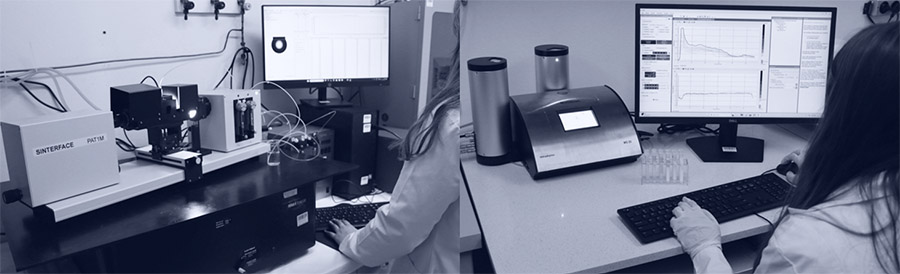
Application of advanced experimental techniques (tensiometry, interfacial rheology, microscopy) and digital image analysis methods for the characterization of structure and dynamics in multiphase systems.
Research carried out in the laboratory combines a fundamental approach with application-oriented objectives, including the development of materials for cosmetic, pharmaceutical, food and environmental technologies.